
Judicial Recognition of Household Care Work as Economic Contribution
Context
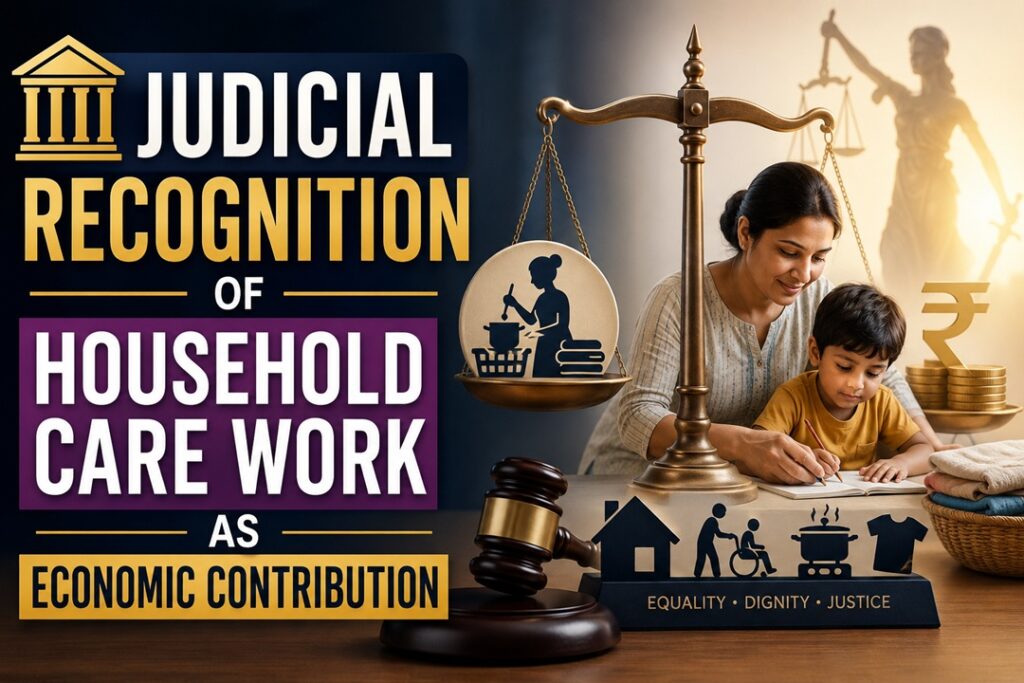
In a significant move toward social and economic justice, the Supreme Court of India (2026) acknowledged unpaid household work as a measurable economic activity. The judgment emphasizes that homemakers are not merely caregivers but essential contributors to family welfare and national development.
Understanding the Supreme Court’s 2026 Verdict on Household Care Work
What Does the Judgment State?
- The Supreme Court addressed the long-standing challenge of assigning economic value to unpaid household responsibilities performed by homemakers.
- It introduced a separate compensation category termed “Domestic Support Loss”, distinguishing the economic services provided within a household from emotional suffering caused by the loss of a family member.
- The ruling seeks to ensure that compensation mechanisms reflect the actual value of domestic management and caregiving.
Key Findings and Data Highlights
Household Work and the Economy
- Referring to the National Statistical Office (NSO) Time Use Survey, the Court noted that unpaid care and domestic work performed by women contributes substantially to India’s economy.
- Estimates suggest that such work accounts for nearly one-sixth of national economic output, despite remaining outside formal accounting systems.
Unequal Distribution of Domestic Responsibilities
- Women in the working-age group devote over seven hours daily to unpaid household activities.
- Men spend significantly fewer hours on comparable domestic responsibilities, indicating a persistent gender gap in care work.
Delays in Compensation Delivery
- Examination of numerous accident compensation cases revealed prolonged judicial delays.
- Several families waited years, and in some cases decades, for final compensation, highlighting the need for faster adjudication.
Enhanced Compensation Standards
- Applying modern valuation methods, the Court substantially increased compensation calculations for deceased homemakers.
- The revised framework recognizes the economic dependency created by domestic services rather than relying on outdated nominal figures.
Why Valuing Unpaid Household Work Matters
Addressing Economic Invisibility
- Household labor remains absent from conventional GDP calculations despite supporting workforce productivity and social stability.
- Recognizing this contribution corrects a long-standing gap in economic assessment.
The Homemaker as a Primary Educator
- Homemakers play a vital role in nurturing children, imparting language skills, social values, and foundational learning.
- These contributions generate long-term social and human capital benefits.
Supporting Productive Economic Activity
- Effective household management enables earning family members to pursue employment and professional growth.
- Domestic care functions as an essential support system for the broader economy.
Separating Economic Value from Emotional Compensation
- Earlier compensation frameworks largely focused on emotional loss through limited consortium payments.
- The new approach recognizes that domestic services have measurable economic worth independent of emotional relationships.
Evolution of Judicial Thinking on Homemakers’ Contributions
Early Recognition Phase (2001)
- Judicial decisions at the beginning of the century acknowledged that homemakers’ efforts could not be treated as valueless.
- Courts introduced notional income concepts to estimate their contribution in compensation cases.
Legislative Compensation Models
- Earlier legal provisions assigned very low fixed income assumptions for non-earning individuals, often resulting in inadequate compensation.
Expansion of Judicial Interpretation (2010)
- The Supreme Court clarified that a homemaker’s role extends beyond routine chores and cannot be equated solely with paid domestic assistance.
Standardization Efforts (2017)
- Constitutional Bench decisions streamlined compensation calculations for accident claims.
- However, the absence of a dedicated mechanism for valuing household work remained unresolved until the latest ruling.
New Framework for Calculating Domestic Care Loss
Eligibility Conditions
The compensation mechanism applies when:
- The deceased was actively engaged in household management and caregiving.
- Children lose parental guidance and care.
- Family members lose essential day-to-day domestic support.
Standard Monthly Valuation
- A baseline value of ₹30,000 per month has been prescribed for unpaid household work.
- This amount serves as the starting point for compensation calculations using age-based multipliers and future prospects.
Additional Income Provision
- If the homemaker was also employed in paid work, the domestic care valuation will be considered in addition to verified employment earnings.
Periodic Upward Revision
- The benchmark amount will undergo periodic enhancement to account for inflation and changing economic conditions.
The Road Ahead
Reforming Compensation Tribunals
- Motor Accident Claims Tribunals should adopt the new valuation framework uniformly.
- Reliance on outdated nominal income assumptions must be phased out.
Reducing Judicial Backlogs
- Dedicated benches and expedited procedures can help resolve compensation disputes more efficiently.
- Priority should be given to long-pending cases affecting vulnerable families.
Leveraging Digital Systems
- Integration of insurance records and tribunal databases can improve transparency and speed in claim processing.
- Technology-driven assessment mechanisms can reduce procedural delays.
Conclusion
The Supreme Court’s 2026 ruling marks a transformative step in recognizing unpaid household work as a genuine economic contribution. By establishing a dedicated compensation framework and assigning a realistic monetary value to domestic care, the judgment strengthens gender justice, acknowledges the indispensable role of homemakers, and moves India closer to a more inclusive understanding of economic productivity.
Source : The Indian Express