
Rise of Drone Warfare: Redefining the Future of Military Conflict
Context
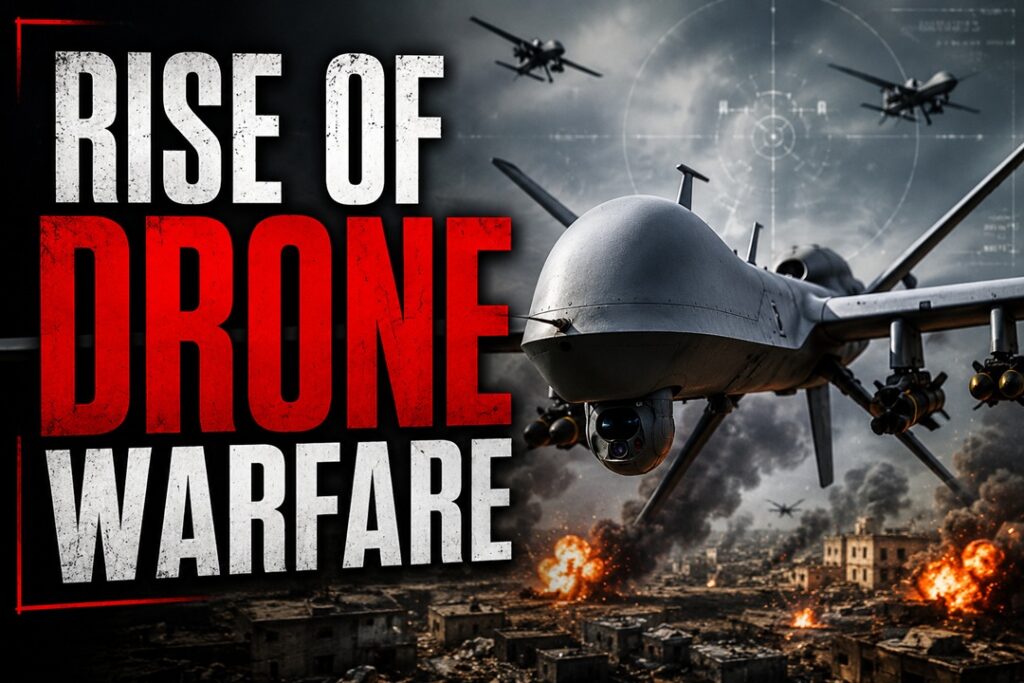
Recent conflicts in Ukraine, Lebanon, and West Asia have demonstrated that drones have evolved from support assets into core instruments of warfare. Their increasing use for surveillance, precision strikes, intelligence gathering, and strategic attacks is transforming battlefield dynamics and challenging traditional military doctrines worldwide.
How is Warfare Transitioning from Platform-Centric to Drone-Driven Operations?
Traditional Military Paradigm
For much of the modern era, military dominance was associated with the possession of advanced combat aircraft, heavy armoured formations, long-range artillery, naval battle groups, and sophisticated missile arsenals.
Nations with substantial defence spending enjoyed significant operational advantages, while weaker states and insurgent groups often depended on irregular warfare methods such as hit-and-run attacks, sabotage, and insurgency tactics.
Emerging Battlefield Reality
Recent wars have challenged these assumptions.
Affordable drones, many based on commercial technologies, are now capable of performing missions once reserved for expensive military platforms.
This transformation has expanded access to advanced combat capabilities, enabling smaller states and non-state groups to contest technologically superior opponents.
Consequently, military effectiveness increasingly depends on the capacity to manufacture, deploy, and neutralize large numbers of drones alongside conventional weapon systems.
The Rise of Large-Scale Drone Warfare
Ukraine as a Testing Ground
The Russia–Ukraine war has become the clearest example of large-scale drone integration in modern combat.
Initially dominated by tanks, artillery, and air power, the conflict rapidly evolved into a drone-intensive war.
Ukraine began by adapting commercially available drones used for civilian applications such as photography, surveying, and monitoring.
These platforms were subsequently modified for:
- Battlefield reconnaissance
- Target acquisition
- Artillery adjustment
- Intelligence collection
As the conflict progressed, drones evolved into precision-strike platforms capable of attacking troops, vehicles, and strategic infrastructure.
Expanding Operational Roles
By 2024, drones had become integral to military operations through:
- Real-time surveillance
- Fire-control support
- Precision engagement of armoured targets
- Attacks on logistics networks
- Tracking troop movements
The conflict demonstrated that continuous aerial observation can make concealment and manoeuvre increasingly difficult on the modern battlefield.
The Emergence of FPV Attack Systems
Evolution of FPV Technology
One of the most influential innovations has been the widespread adoption of First-Person View (FPV) drones.
Originally designed for recreational racing, these systems are controlled through live video feeds viewed via specialized headsets.
Key Advantages
FPV drones provide:
- Exceptional manoeuvrability
- Accurate target engagement
- Low manufacturing costs
- Easy customization
Many have been converted into one-way attack systems carrying explosive payloads.
These platforms function as inexpensive precision weapons capable of destroying high-value military assets.
Changing Battlefield Economics
A relatively inexpensive drone can eliminate equipment worth millions of dollars.
This cost imbalance is forcing militaries worldwide to reconsider investments in traditional high-cost platforms operating within drone-saturated environments.
What are the Major Innovations Reshaping Drone Combat?
Autonomous Loitering Weapons
These systems merge reconnaissance and strike functions.
They can patrol designated areas, identify targets, and launch attacks when opportunities arise.
Such capabilities are particularly effective against air-defence systems, command centres, and logistical assets.
Reusable Aerial Bombing Platforms
Commercial drones have been modified to carry explosive devices, anti-armour munitions, and improvised payloads.
Unlike one-way attack drones, they can conduct repeated missions, making them highly economical force multipliers.
Deep-Strike Unmanned Systems
Long-range drones are increasingly being used to attack supply depots, military installations, and strategic infrastructure far behind enemy lines.
This demonstrates their growing role in strategic warfare beyond frontline operations.
Fibre-Linked Drone Technology
A major recent advancement is the deployment of fibre-connected FPV drones.
Instead of relying on radio communications, these systems transmit commands and video signals through ultra-thin fibre-optic cables.
Advantages
- Immunity to electronic jamming
- Reliable communications in contested environments
- Greater effectiveness against electronic warfare systems
This innovation reflects the continuing competition between drone technologies and counter-drone measures.
How Has Drone Warfare Expanded in West Asia?
Hezbollah’s Expanding UAV Network
Hezbollah has developed a significant drone inventory based largely on Iranian technology.
Platforms from the Ababil, Mohajer, and Shahed families support:
- Intelligence collection
- Surveillance operations
- Target designation
- Precision strike missions
Reports suggest increasing use of fibre-optic systems to overcome electronic countermeasures.
Israel’s Multi-Layered Defence Framework
Israel has invested heavily in anti-drone technologies.
Its defence architecture includes:
- Electronic warfare capabilities
- Dedicated detection radars
- AI-assisted tracking systems
- Hard-kill interception mechanisms
Innovative drone-versus-drone interception concepts are also being explored to reduce dependence on costly missile interceptors.
Iran’s Strategic UAV Doctrine
Iran employs drones not only for tactical operations but also as instruments of deterrence and regional influence.
Through indigenous production and support to allied groups, Iran has demonstrated the ability to threaten military facilities, energy infrastructure, and maritime targets at comparatively low cost.
This illustrates the growing geopolitical significance of drone technology.
What are the Strategic Implications for Modern Militaries?
Continuous Battlespace Awareness
Persistent drone surveillance has created an environment where troop movements and military activities are constantly monitored.
The distinction between frontlines and rear areas is gradually diminishing.
Increasing Vulnerability of Conventional Assets
Tanks, artillery systems, command posts, and naval vessels face growing risks from low-cost drone attacks.
This challenges traditional assumptions regarding force protection and military investment.
Central Role of Electronic Warfare
Control of the electromagnetic spectrum has become a decisive factor in military operations.
Electronic warfare capabilities are now indispensable for both offensive and defensive missions.
Importance of Defence Manufacturing
Success increasingly depends on the ability to rapidly produce drones, replace battlefield losses, and innovate continuously.
Industrial capacity has emerged as a key determinant of military power.
What are the Key Challenges?
Despite their operational advantages, drones raise several concerns:
- Increased risk of conflict escalation through inexpensive strikes
- Difficulties in regulating proliferation
- Greater exposure of civilian infrastructure to attacks
- Ethical issues related to autonomous targeting technologies
- Enhanced capabilities for non-state actors and terrorist groups
These challenges highlight the need for international frameworks governing the use of military drones.
Future Outlook
The rapid expansion of drone technology represents one of the most significant transformations in military affairs since the advent of precision-guided weapons.
Recent conflicts demonstrate that battlefield success is no longer determined solely by expensive weapon systems or defence spending levels.
Instead, military effectiveness increasingly depends on technological adaptability, industrial resilience, innovation, and the ability to integrate unmanned systems across operational domains.
As drones become more affordable, autonomous, and widely accessible, they will continue to reshape military doctrines, strategic planning, and global security dynamics.
In the evolving security environment of the twenty-first century, drones have moved beyond being supplementary tools and are becoming the backbone of future warfare.
Source : The Hindu