
Rajasthan’s First Land Pooling Policy: Transforming Land Assembly for Infrastructure Development
Context
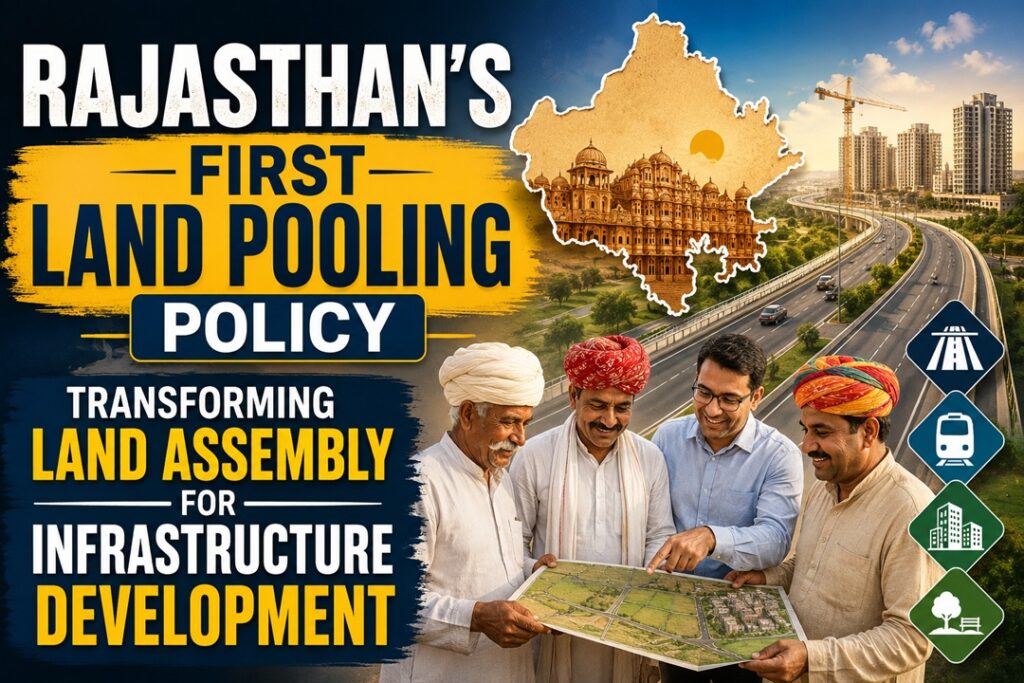
Rajasthan has unveiled its first-ever Land Pooling Policy to facilitate faster land assembly for roads, urban infrastructure, and public development projects while reducing dependence on compulsory land acquisition.
Land Pooling: A Collaborative Alternative to Traditional Land Acquisition
Understanding Land Acquisition
What Does Land Acquisition Mean?
Land acquisition refers to the legal process through which the government acquires privately owned land for public purposes such as infrastructure development, industrial corridors, urban expansion, or strategic projects.
Under this framework, ownership of the land is permanently transferred to the state in exchange for monetary compensation and rehabilitation benefits prescribed by law.
Understanding the Land Pooling Mechanism
What Is Land Pooling?
Land pooling is a participatory urban development approach in which multiple landowners voluntarily contribute their land parcels to a designated planning authority for integrated development.
After infrastructure such as roads, drainage systems, utilities, parks, and public amenities is created, a portion of the developed land is returned to the original owners. Though smaller in size, these plots generally possess significantly higher market value due to improved infrastructure and connectivity.
How the Model Operates
- Landowners voluntarily surrender land to the planning authority.
- A part of the pooled land is reserved for public infrastructure and civic amenities.
- Remaining land is reconstituted into serviced plots.
- Developed plots are returned to original landowners.
- Value appreciation compensates owners for the land contributed.
Legal Framework Governing Land Acquisition in India
RFCTLARR Act, 2013
The principal legislation is the Right to Fair Compensation and Transparency in Land Acquisition, Rehabilitation and Resettlement (RFCTLARR) Act, 2013.
Major Provisions
Consent-Based Acquisition
- Consent of 70% affected families is required for PPP projects.
- Consent of 80% affected families is required for private sector projects.
Social Impact Assessment (SIA)
- Mandatory evaluation of social, economic, and environmental consequences before acquisition.
Enhanced Compensation Structure
- Compensation may reach up to four times market value in rural areas and twice market value in urban areas.
- Includes 100% solatium over the compensation amount.
Rehabilitation and Resettlement Safeguards
- Provides benefits not only to landowners but also to affected workers and dependent families.
Protection of Agricultural Land
- Restricts acquisition of fertile multi-crop agricultural land except under exceptional circumstances.
Persistent Challenges in Conventional Land Acquisition
Escalating Project Costs
Extensive compensation and rehabilitation requirements significantly increase infrastructure expenditure.
Example: Large transport and urban projects often face cost overruns due to compensation obligations.
Lengthy Administrative Procedures
Multiple approvals, assessments, and consultations extend project timelines.
Example: Completion of SIAs and dispute resolution processes can delay projects for years.
Displacement and Social Disruption
Forced acquisition may uproot communities from their traditional settlements and livelihoods.
Example: Rural households frequently lose social and economic support systems after relocation.
Frequent Legal Disputes
Differences over valuation and compensation often trigger prolonged litigation.
Example: Court cases regarding land valuation can halt project execution for extended periods.
Successful Land Pooling Experiences in India
Gujarat Town Planning Scheme (TPS)
Implemented under the Gujarat Town Planning and Urban Development Act, 1976, the TPS model has enabled planned urban expansion across Ahmedabad, Surat, Vadodara, Rajkot, and Gandhinagar.
Key Achievement: Landowners become development partners rather than recipients of compensation alone.
Guwahati Land Pooling Initiative
The Guwahati Metropolitan Development Authority adapted the model to local conditions by minimizing land contribution requirements and utilizing existing land records.
Key Achievement: Improved stakeholder acceptance while expediting road and urban infrastructure development.
Why Land Pooling Is Emerging as a Preferred Solution
Promotes Voluntary Participation
The model emphasizes cooperation instead of compulsory acquisition.
Benefit: Reduced resistance from landowners and fewer legal challenges.
Reduces Fiscal Burden on Governments
Authorities need not mobilize massive funds for upfront compensation.
Benefit: Infrastructure development becomes financially sustainable.
Minimizes Displacement
Landowners continue to remain within their original locality.
Benefit: Community networks and livelihoods remain largely intact.
Creates Shared Economic Gains
Landowners directly benefit from rising land values after development.
Benefit: Infrastructure-led appreciation generates wealth for participating communities.
Accelerates Urban Infrastructure Creation
Availability of contiguous land speeds up project implementation.
Benefit: Faster delivery of roads, utilities, and public facilities.
Policy Measures for Effective Implementation
Digitization of Land Records
Comprehensive GIS mapping and drone-based surveys should be completed before launching pooling projects.
Transparent Benefit-Sharing Framework
Clear disclosure of land contribution ratios and expected returns can improve public confidence.
Protection of Vulnerable Stakeholders
Dedicated provisions should safeguard tenants, labourers, and informal livelihood groups affected by development.
Strengthening Urban Planning Institutions
Local planning authorities require greater legal, financial, and administrative capacity.
Interim Income Support Mechanisms
Temporary annuity payments can support landowners during the development period before plots are returned.
Conclusion
Land pooling represents a transformative shift from compulsory acquisition toward cooperative urban development. By aligning the interests of governments, planners, and landowners, it offers a viable pathway to build infrastructure efficiently while reducing litigation, displacement, and fiscal pressures. As urbanization accelerates, well-designed land pooling frameworks can become a cornerstone of sustainable and inclusive city development in India.
Source : The Hindu