
Reimagining India’s Education System
Context
A nationwide debate on education reform has intensified following repeated concerns over examination integrity, paper leaks, and governance failures. The discussion has renewed focus on building a transparent, skill-oriented, and future-ready education system.
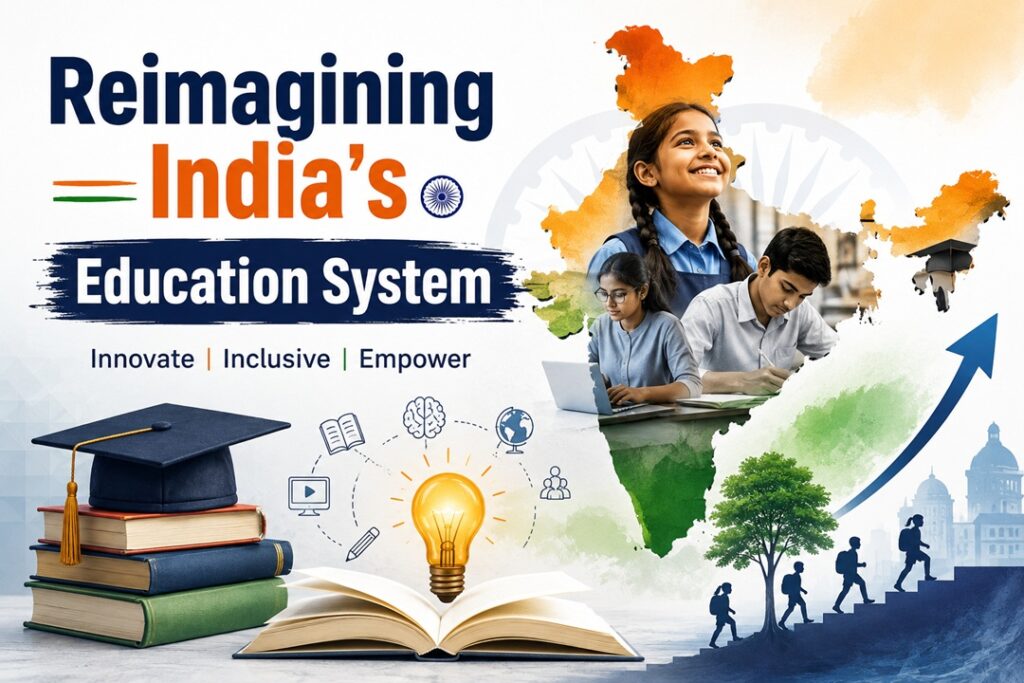
About Reimagining India’s Education System
What is it?
Reimagining India’s education system refers to transforming the existing examination-oriented model into a learner-centric framework that promotes conceptual understanding, critical thinking, creativity, innovation, and employability. The objective is to move beyond rote memorization and create an education ecosystem that prepares students for real-world challenges while ensuring equitable access to quality education.
Key Data and Statistics on India’s Education Sector
Large Skill Development Gap
Although school and higher education enrollment has increased substantially, nearly 65% of India’s workforce still lacks formal vocational or technical training, limiting productivity and employment opportunities.
Rapid Growth of the Coaching Industry
The heavy dependence on competitive entrance examinations has resulted in a rapidly expanding private coaching industry, placing considerable financial pressure on families.
Mismatch Between Education and Employment
A significant proportion of graduates continue to work in low-skilled jobs because academic qualifications often fail to match industry requirements.
Growing Need for Examination Reforms
Education experts have recommended gradually transforming national examinations such as JEE, NEET, CUET, and UPSC into competency-based assessments that evaluate analytical ability and practical application rather than memory alone.
Major Challenges in India’s Education System
Examination-Centric Learning
The existing education system largely rewards memorization instead of conceptual understanding, analytical reasoning, and innovation.
Example: Students often spend years preparing for competitive examinations through repetitive learning rather than developing practical knowledge.
Expanding Coaching Culture
Increasing competition for limited educational opportunities has made private coaching an essential part of examination preparation for many students.
Example: Major coaching hubs continue to attract students from across the country for engineering, medical, and civil services examinations.
Teacher Shortages
Many government schools, colleges, and higher educational institutions continue to face significant faculty shortages, affecting learning quality.
Example: Vacant teaching positions in universities and technical institutions reduce student-teacher interaction and research output.
Limited Academic Autonomy
Educational institutions often face administrative constraints that delay curriculum modernization and innovative teaching methods.
Example: Universities frequently require lengthy approval processes before introducing updated courses aligned with emerging technologies.
Implications of Weaknesses in the Education System
Underutilization of India’s Demographic Dividend
Without quality education and market-oriented skills, India’s young population may struggle to contribute effectively to economic growth.
Example: Many educated youth remain unemployed or underemployed despite possessing academic degrees.
Increasing Educational Inequality
Students from economically weaker sections face disadvantages because quality education and coaching remain expensive.
Example: Rural and low-income students often have limited access to advanced learning resources and competitive coaching.
Graduate Unemployment
An increasing number of highly qualified graduates compete for a limited number of government and entry-level jobs.
Example: Candidates with postgraduate qualifications frequently apply for clerical and Group D positions.
Declining Confidence in Government Education
Differences in infrastructure, learning outcomes, and facilities between government and private institutions encourage migration toward private education.
Example: Families often choose private schools because of better laboratories, digital classrooms, and teaching quality.
Way Forward
Adopt Competency-Based Assessments
Redesign school and entrance examinations to evaluate conceptual understanding, critical thinking, creativity, communication, and practical problem-solving.
Reduce Dependence on Coaching
Strengthen classroom teaching through continuous assessments, project-based learning, and multiple examination opportunities.
Improve Teacher Quality
Enhance teacher recruitment, professional development, digital training, and research support to improve classroom outcomes.
Fill Teaching Vacancies
Conduct transparent and time-bound recruitment to fill vacancies across schools, colleges, universities, and technical institutions.
Strengthen Governance and Accountability
Develop transparent education dashboards, independent performance reviews, and evidence-based policymaking to improve learning outcomes.
Promote Skill-Oriented Education
Integrate vocational education, internships, entrepreneurship, digital literacy, and industry collaboration into mainstream education.
Conclusion
India’s long-term development depends on creating an education system that values critical thinking, innovation, practical skills, and equal opportunities rather than rote memorization alone. By strengthening governance, improving teaching quality, reforming examinations, and promoting competency-based learning, India can build a globally competitive education system capable of preparing future generations for the demands of the 21st-century economy.
Source : The Hindu