
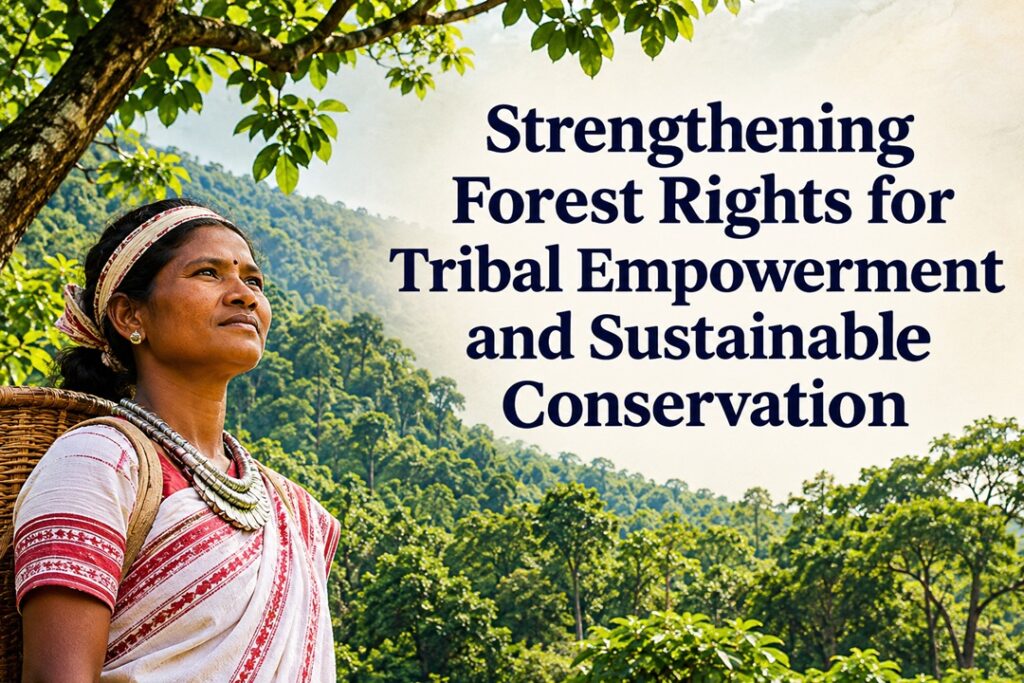
Strengthening Forest Rights for Tribal Empowerment and Sustainable Conservation
Context
The Ministry of Tribal Affairs launched the National Forest Rights Act (FRA) Digital Platform during Janjatiya Gaurav Pakhwada 2026 to streamline the recognition and distribution of forest rights through digital technology. As of August 2026, 25.42 lakh titles covering 238 lakh acres had been distributed across the country, marking significant progress in securing the land and livelihood rights of forest-dependent communities.
Forest Rights Act, 2006: Recognising Historical Rights
The Scheduled Tribes and Other Traditional Forest Dwellers (Recognition of Forest Rights) Act, 2006, commonly known as the Forest Rights Act (FRA), seeks to correct historical injustices by recognising the customary rights of communities that have traditionally depended on forests. Enacted in December 2006 and brought into force on December 31, 2007, the legislation provides legal protection to their land, livelihood and forest management rights.
The Ministry of Tribal Affairs acts as the nodal ministry responsible for implementing the Act.
Eligibility and Beneficiaries
The Act covers two major categories of forest-dependent communities:
- Forest-Dwelling Scheduled Tribes (FDSTs): Scheduled Tribe members who primarily reside in forests and depend on forest land for legitimate livelihood requirements before December 13, 2005.
- Other Traditional Forest Dwellers (OTFDs): Communities that have primarily resided in and depended on forest land for at least three generations (75 years) before December 13, 2005.
Major Rights Recognised under the Act
- Individual Forest Rights (IFR): Provides eligible families with inheritable rights over forest land for habitation and self-cultivation, subject to a maximum of four hectares. Titles are issued jointly in the names of both spouses.
- Community Forest Rights (CFR): Recognises community entitlements over traditional resources, including grazing grounds, water bodies, fishing areas and Minor Forest Produce (MFP), such as bamboo, honey and medicinal plants.
- Community Forest Resource Rights (CFRR): Empowers Gram Sabhas to protect, regenerate and sustainably manage forests within their customary boundaries.
- Habitat Rights for PVTGs: Safeguards the traditional habitats and socio-cultural practices of Particularly Vulnerable Tribal Groups, including within reserved and protected forests. Such rights have been recognised for 11 PVTGs across Odisha, Chhattisgarh and Madhya Pradesh.
- Land Diversion for Essential Facilities: Allows diversion of up to one hectare of forest land per project for specified basic public utility facilities, subject to Gram Sabha recommendation and prescribed conditions.
Three-Tier Mechanism for Recognition of Claims
The FRA establishes a decentralised process in which local communities play a central role in determining forest rights.
- Gram Sabha: Acts as the initiating authority and constitutes a Forest Rights Committee comprising 10–15 members. The committee receives applications, verifies claims and maps customary boundaries before the Gram Sabha adopts a resolution.
- Sub-Divisional Level Committee (SDLC): Examines Gram Sabha resolutions, considers appeals and prepares the draft Record of Forest Rights.
- District Level Committee (DLC): Functions as the final decision-making authority. Headed by the District Collector, it includes representatives from relevant departments and issues the final forest rights titles.
Implementation Progress and Recent Initiatives
The implementation of FRA has expanded through digital governance, institutional support and integration with rural welfare programmes.
- Progress in Title Distribution: By August 2026, approximately 43.56 lakh out of 54 lakh claims had been disposed of, with 25.42 lakh titles distributed over 238 lakh acres. Chhattisgarh, Odisha and Madhya Pradesh have been among the leading implementing States.
- National FRA Digital Platform (2026): Introduces an integrated digital mechanism for processing claims, GIS-based boundary mapping, monitoring committee decisions and issuing digitally signed titles. It aims to improve transparency and administrative efficiency.
- Dharti Aaba Janjatiya Gram Utkarsh Abhiyan (DA-JGUA): Supports State and district-level FRA cells, with financial assistance of ₹25 lakh per State for forest mapping and ₹15 lakh per Gram Sabha for preparing community forest management plans.
- Integration with Revenue Records: Efforts are underway to connect forest rights titles with land administration and welfare databases. Maharashtra has introduced Village Forms 7E and 12E to facilitate access to crop loans, Kisan Credit Cards and PM-KISAN. Andhra Pradesh and Telangana have also integrated FRA-related digital platforms with revenue and banking systems.
Major Challenges in FRA Implementation
Despite considerable progress in title distribution, institutional weaknesses and administrative bottlenecks continue to undermine the effective realisation of forest rights.
- Arbitrary Rejection of Claims: Many applications are rejected without adequate justification, limiting transparency and access to effective remedies. OTFD applicants particularly face difficulties in establishing 75 years of residence because of stringent documentary requirements.
- Incomplete Revenue Record Integration: Delays in updating land records after title distribution prevent beneficiaries from accessing formal credit and agricultural welfare schemes. For instance, IFR holders may struggle to obtain Kisan Credit Cards and crop insurance.
- Limited Recognition of Community Rights: Community titles account for less than 5% of distributed titles, indicating that implementation remains disproportionately focused on individual ownership rather than collective forest governance. Differences between Gram Sabha management plans and Forest Department working plans further complicate implementation.
- Conflicts in Protected Areas: Forest-dwelling communities within national parks and tiger reserves continue to face relocation pressures. Such developments raise concerns about compliance with Section 4(5), which prohibits eviction or removal until the recognition and verification process is complete.
- Institutional and Capacity Constraints: Inadequate training of officials, limited awareness among tribal communities and weak coordination between departments delay the processing of claims and recognition of community rights.
Way Forward
- Ensure Transparent Claim Processing: Introduce mandatory, time-bound reviews of rejected applications by SDLCs and DLCs. Every rejection should be supported by a written, reasoned order communicated to the claimant, along with information about appeal mechanisms.
- Integrate Forest Titles with Revenue Records: Scale up models adopted by Maharashtra and Andhra Pradesh through the National FRA Digital Platform to ensure automatic mutation of revenue records following title distribution.
- Prioritise Community and Habitat Rights: Accelerate the recognition of CFRR and PVTG habitat rights through dedicated State FRA cells, GIS mapping and effective utilisation of DA-JGUA financial assistance.
- Strengthen Gram Sabha Institutions: Provide legal awareness programmes, technical assistance and capacity-building initiatives to enable Gram Sabhas to effectively manage community forest resources.
- Improve Interdepartmental Coordination: Establish stronger coordination between the Ministry of Tribal Affairs, Ministry of Environment, Forest and Climate Change and State governments to harmonise tribal rights with biodiversity conservation and ecological restoration.
- Promote Welfare Convergence: Link recognised forest titles with institutional credit, agricultural insurance, livelihood programmes and other government benefits to translate legal ownership into tangible socio-economic development.
Conclusion
The Forest Rights Act, 2006, represents an important shift from exclusionary forest administration towards rights-based and community-centred governance. While the distribution of 25.42 lakh titles over 238 lakh acres reflects substantial progress, its success must be measured beyond individual land ownership. Transparent claim verification, stronger community forest rights and effective welfare convergence are essential to achieving tribal empowerment, social justice and sustainable forest conservation.
Source: PIB