
Swachhata Hi Seva 2026: From ODF Villages to Sustainable Sanitation and Circular Economy
Context
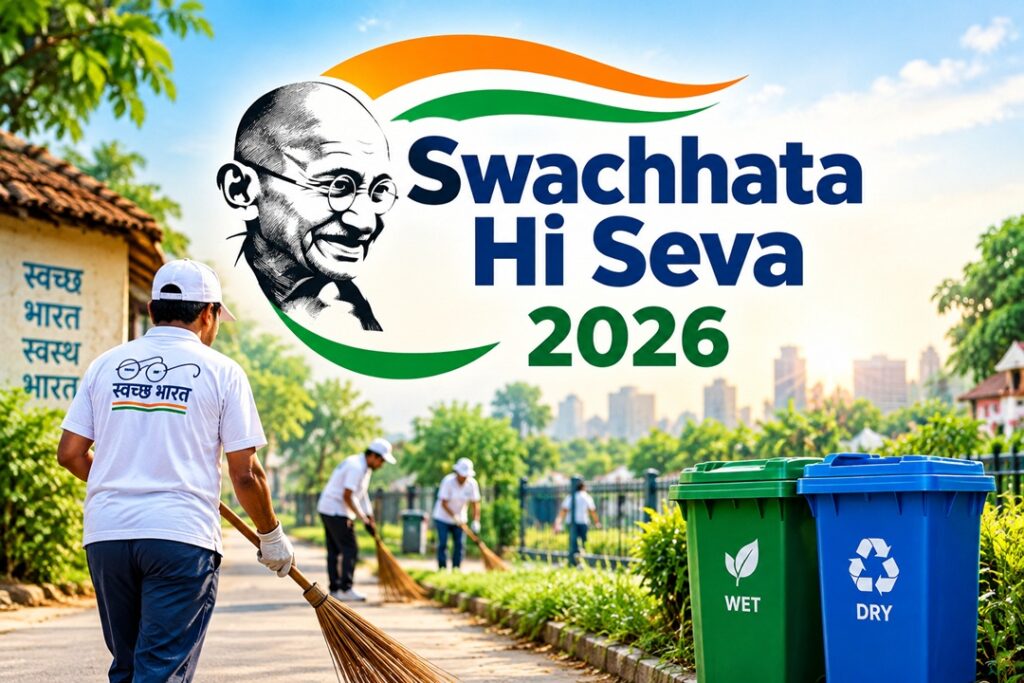
The Swachhata Hi Seva (SHS) 2026 campaign marks the next phase of India’s sanitation journey, moving beyond toilet construction and Open Defecation Free (ODF) status towards waste management, behavioural change, community participation and sanitation-linked livelihoods. The campaign begins on September 17, 2026, with the theme “Swachhata Mein Sahbhag; Swachh Bharat, Viksit Bharat.”
India’s rural sanitation coverage has risen from 39% in 2014 to universal ODF status in 2019, creating the foundation for a broader sanitation ecosystem.
From Toilet Access to ODF Plus
The first phase of the Swachh Bharat Mission-Gramin (SBM-G) concentrated on eliminating open defecation and expanding household toilet access. More than 10.28 crore toilets were constructed between 2014 and 2019.
The second phase has shifted the emphasis towards sustaining ODF behaviour and creating systems for Solid and Liquid Waste Management (SLWM).
As of September 2026:
- 5.69 lakh villages have achieved ODF Plus status.
- 5.25 lakh villages have reached the ODF Plus Model category.
- 5.38 lakh villages have systems for solid waste management.
- 5.65 lakh villages have liquid waste management arrangements.
- 1,314 GOBARdhan biogas plants are operational across 582 districts.
- Around 12.22 crore individual household toilets and 98,273 household biogas plants have been established.
Understanding ODF Plus Categories
ODF Plus represents a progression from merely ending open defecation to creating clean and sustainable villages.
- Aspiring: The village manages either solid or liquid waste.
- Rising: Both solid and liquid waste are managed.
- Model: Both waste streams are managed, while the village also maintains visual cleanliness and promotes ODF Plus messaging.
Thus, sanitation is increasingly being treated as a continuous public-service system rather than a one-time infrastructure programme.
Behaviour Change as the Foundation
Infrastructure alone cannot ensure lasting sanitation outcomes. The SHS approach therefore places greater emphasis on developing everyday habits.
These include:
- Regular and safe use of toilets.
- Proper maintenance of sanitation infrastructure.
- Segregation and treatment of household waste.
- Composting or biogas generation from wet waste.
- Handwashing and safe storage of drinking water.
- Preventing littering and spitting in public places.
The objective is to make cleanliness an established social practice rather than an activity undertaken only during campaigns.
Women and Community Institutions
Women-led institutions have emerged as important actors in sanitation and waste management. Swachhagrahis and Self-Help Groups (SHGs) are involved in awareness campaigns, door-to-door mobilisation, cleanliness monitoring and waste recovery.
Examples demonstrate how sanitation can simultaneously generate community benefits and livelihood opportunities:
- In Howrah, SHGs collected 9.32 tonnes of plastic waste from 18 Ganga-adjacent Gram Panchayats within 18 days.
- In Gorakhpur, SHG members operate a Resource Recovery Centre, converting wet waste into vermicompost and generating income through dry-waste recovery.
- In Bhopal, a Cluster Level Federation operates a Material Recovery Facility in collaboration with SBM-G.
These initiatives connect women’s collective action with environmental management and local economic activity.
Schools and Youth as Agents of Behavioural Change
Schools can create a bridge between institutional learning and household practices. Children exposed to waste segregation, hygiene and responsible consumption can carry these practices into their homes.
Local initiatives include:
- Schools in Chandil, Jharkhand, adopting measures such as banning single-use plastic and constructing soak pits for greywater.
- Child Cabinets participating in menstrual hygiene management.
- A dedicated menstrual hygiene management laboratory being established at a Kasturba Gandhi Balika Vidyalaya.
SHS 2026 further emphasises youth participation through activities such as Swachhata Gyan Yatras, School Samvads and awareness about the Solid Waste Management Rules, 2026.
This approach seeks to make sanitation part of children’s everyday civic behaviour or sanskaar.
Strengthening Local Governance
Sustainable sanitation requires institutions capable of maintaining infrastructure after its creation.
Gram Panchayats play a central role in planning, implementation, community mobilisation and Information, Education and Communication (IEC) activities. Village Water and Sanitation Committees (VWSCs) support village-level monitoring and implementation.
The experience of Gadli Gram Panchayat in Haryana illustrates an integrated model involving:
- Community toilets.
- Village drainage infrastructure.
- A five-pond greywater treatment system.
- GOBARdhan facilities producing biogas and agricultural manure.
Such decentralised systems can help villages address sanitation, wastewater management and resource recovery together.
Jan Bhagidari and Swachhata Hi Seva
The campaign places community participation or Jan Bhagidari at the centre of sanitation governance.
Government allocations, Finance Commission grants and Viksit Bharat-Gramin programmes provide institutional support, while community initiatives supplement formal government systems.
A notable example is Swachh Sanivara in Karnataka, where cleanliness drives are conducted on the first Saturday of every month in schools, temples and public spaces.
The scale of participation in SHS has also expanded. In 2025, more than 18.06 crore citizens participated in the campaign.
For 2026, collective “Ek Din, Ek Ghanta, Ek Saath” shramdaan is planned for October 1, followed by Special Gram Sabhas on October 2.
Sanitation as an Economic Opportunity
The sanitation sector is increasingly developing into a local economic ecosystem involving waste collection, recycling, composting, wastewater treatment and specialised construction skills.
Examples include:
- Betul, Madhya Pradesh: Babita Dhurve became the district’s first female e-rickshaw waste collector, encouraging around 100 Gram Panchayats to introduce waste-collection vehicles.
- Nadia, West Bengal: Two masonry training institutes have trained around 2,400 men and women in specialised toilet construction.
- Vedancha, Gujarat: A decentralised system treats approximately 200 KL of greywater daily for irrigation and groundwater recharge. The Gram Panchayat earns around ₹2.5 lakh annually through compost and treated-water sales.
This demonstrates the possibility of transforming waste from a disposal problem into a resource and source of rural livelihoods.
Way Forward
The next stage of rural sanitation should focus on ensuring that ODF Plus achievements remain sustainable. This requires:
- Reliable operation and maintenance of waste-management infrastructure.
- Greater segregation of waste at source.
- Strengthening Gram Panchayats and VWSCs with technical and financial capacity.
- Expanding women-led waste enterprises and local recycling chains.
- Linking sanitation with circular-economy opportunities such as compost, biogas and treated wastewater.
- Continuous behavioural campaigns rather than one-time mobilisation.
- Better monitoring of the actual quality and functionality of sanitation services.
Conclusion
India’s sanitation transformation has progressed from toilet access and ODF status towards integrated village sanitation and resource management. Swachhata Hi Seva 2026 reflects this transition by combining infrastructure with behavioural change, women’s participation, youth engagement, decentralised governance and livelihood creation. The long-term success of this next phase will depend not merely on achieving numerical targets, but on ensuring that sanitation systems remain functional, locally managed and embedded in everyday community practices.
Source : PIB