
Towards a TB-Free India: Strengthening Community-Led Disease Elimination
Context
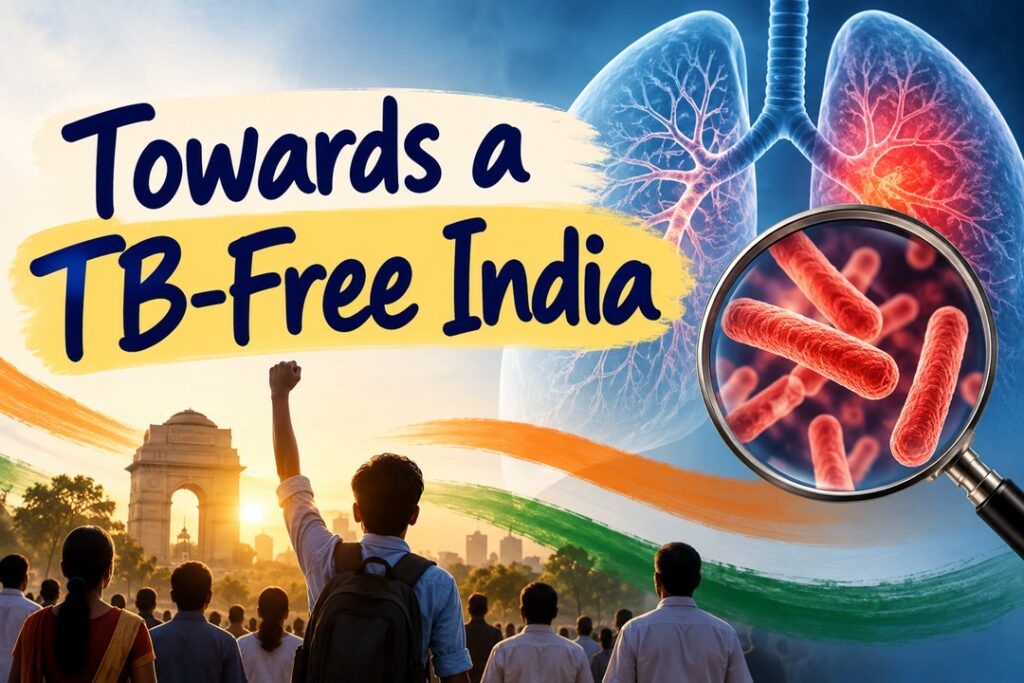
The Ministry of Health and Family Welfare launched the JOSH (Joint Squad for Health) campaign across 11 States and 55 districts to engage young people, NCC cadets and local communities in India’s efforts to eliminate tuberculosis (TB). The initiative highlights the importance of public participation alongside medical interventions in achieving a TB-free India.
What is Tuberculosis?
Tuberculosis is an infectious disease caused by the bacterium Mycobacterium tuberculosis. It primarily affects the lungs but can also damage the brain, bones, kidneys and lymph nodes. Pulmonary TB spreads through the air when an infected person releases infectious particles while coughing, sneezing or speaking.
Major Types of TB
- Latent and Active TB: In latent TB, bacteria remain in the body without causing active illness or spreading the infection. Active TB occurs when the bacteria multiply and produce symptoms.
- Pulmonary and Extrapulmonary TB: Pulmonary TB affects the lungs and can spread to others, while extrapulmonary TB affects organs outside the lungs and is generally not infectious.
- Drug-Susceptible and Drug-Resistant TB: Drug-susceptible TB responds to standard medicines. Drug-resistant forms, including multidrug-resistant TB (MDR-TB), require specialised treatment and more careful monitoring.
India’s Progress in TB Control
India has strengthened its tuberculosis response through expanded diagnostic facilities, improved treatment coverage and community participation.
- Declining disease burden: Between 2015 and 2024, TB incidence in India declined by 21%, compared with a 12% reduction globally. TB-related mortality fell by 28% during the same period.
- Improved treatment coverage: India achieved 92% treatment coverage, exceeding the global figure of 78%.
- Higher treatment success: The treatment success rate under intensified national efforts reached 90%, compared with the global average of 88%.
- Local-level achievements: More than 46,118 Gram Panchayats had received TB-Free Panchayat certification by 2026, reflecting the growing role of local governance in disease elimination.
India had originally set an ambitious target of eliminating TB by 2025, ahead of the global Sustainable Development Goal target of 2030. Although the national deadline has passed, the goal remains an important benchmark for accelerating progress.
India’s Strategy for TB Elimination
1. From Disease Control to a People’s Movement
The National Tuberculosis Elimination Programme (NTEP) follows an integrated approach focused on early detection, effective treatment, prevention and strengthening healthcare infrastructure. The broader strategy seeks to transform TB elimination from a government-led programme into a Jan Andolan involving communities, elected representatives, private healthcare providers and civil society.
2. Nutritional and Community Support
The Pradhan Mantri TB Mukt Bharat Abhiyaan encourages individuals and organisations to support TB patients through the Ni-kshay Mitra initiative. More than 6.77 lakh registered supporters have contributed to supplementary nutritional assistance.
The Ni-kshay Poshan Yojana provides financial support for the nutritional needs of notified TB patients. According to the supplied information, over ₹4,454 crore had been disbursed to approximately 1.38 crore beneficiaries since 2018.
3. Shorter Treatment for Drug-Resistant TB
The introduction of the BPaLM regimen, comprising bedaquiline, pretomanid, linezolid and moxifloxacin, offers an oral treatment option for eligible patients with drug-resistant TB. The six-month regimen can reduce treatment duration compared with older regimens lasting 18–24 months, improving convenience and potentially supporting treatment adherence.
4. Digital Technologies and Advanced Diagnostics
India is expanding molecular testing and digital tools to identify infections earlier. These include CBNAAT and Truenat diagnostic platforms, AI-supported chest X-ray systems and digital triage tools.
Such technologies can improve diagnostic accuracy, identify drug resistance and reduce delays in initiating appropriate treatment, particularly when deployed closer to underserved communities.
Key Challenges in Eliminating TB
1. Incomplete Reporting by Private Healthcare Providers
Many patients initially approach private practitioners, pharmacies or informal healthcare providers. If diagnoses and prescriptions are not reported to the national system, patients may remain outside official surveillance and treatment support mechanisms.
Inappropriate antibiotic combinations or incomplete treatment can delay diagnosis and contribute to drug resistance.
2. Malnutrition and Economic Vulnerability
Undernutrition increases susceptibility to developing active TB and can complicate recovery. Poor nutrition, unstable employment and loss of daily wages may prevent patients from completing treatment and maintaining adequate dietary intake.
Consequently, TB is both a public health challenge and a manifestation of persistent socioeconomic inequality.
3. Stigma and Delayed Diagnosis
Fear of discrimination, social exclusion and marital difficulties can discourage individuals from seeking timely medical care. Women and economically vulnerable groups may be particularly affected by social pressures.
Concealing symptoms allows the disease to progress and increases the risk of transmission within households and communities.
4. Geographic and Diagnostic Barriers
Remote tribal settlements, hilly regions and conflict-affected areas often face shortages of healthcare workers, diagnostic facilities and reliable specimen transportation.
Seasonal isolation and inadequate transport infrastructure can delay diagnosis and treatment, undermining efforts to detect cases before transmission continues.
5. Persistent Latent Infection and Drug Resistance
People with latent TB infection can develop active disease later, particularly when their immune systems weaken. At the same time, drug-resistant strains require specialised treatment and sustained clinical monitoring.
Addressing these challenges requires prevention and follow-up care alongside the treatment of active cases.
Way Forward
- Expand preventive treatment: Strengthen TB preventive treatment for eligible household contacts and other high-risk groups, following appropriate screening and clinical protocols.
- Improve private-sector coordination: Ensure timely notification of cases, standardised treatment and digital integration of private healthcare providers with the Ni-kshay portal.
- Decentralise molecular diagnostics: Expand access to rapid molecular testing through primary healthcare facilities and mobile diagnostic units in underserved regions.
- Strengthen infection prevention: Improve ventilation, respiratory protection and airborne infection-control measures in hospitals, prisons, shelters and other crowded settings.
- Address nutritional insecurity: Ensure timely nutritional assistance, counselling and social protection for patients throughout treatment and recovery.
- Reduce stigma: Promote community awareness, confidentiality and non-discriminatory treatment through youth networks, local leaders and grassroots organisations.
- Support TB survivors: Provide rehabilitation, lung-health monitoring, livelihood assistance and appropriate long-term care for people experiencing post-TB complications.
- Strengthen accountability: Track district-level progress through reliable data, treatment outcomes and periodic assessments to identify underserved populations and implementation gaps.
Conclusion
India’s progress against tuberculosis demonstrates the value of combining modern diagnostics, effective treatment, nutritional support and community participation. However, drug resistance, undernutrition, stigma and unequal access to healthcare continue to obstruct elimination efforts. Initiatives such as JOSH can strengthen public engagement, but lasting success will require a sustained, inclusive and evidence-based approach that prioritises early detection, prevention and equitable access to care. A TB-free India ultimately depends on treating not only the disease but also the social and economic conditions that allow it to persist.
Source : PIB