
Women-Led Development: Advancing Gender Equality Through Property Rights
Context
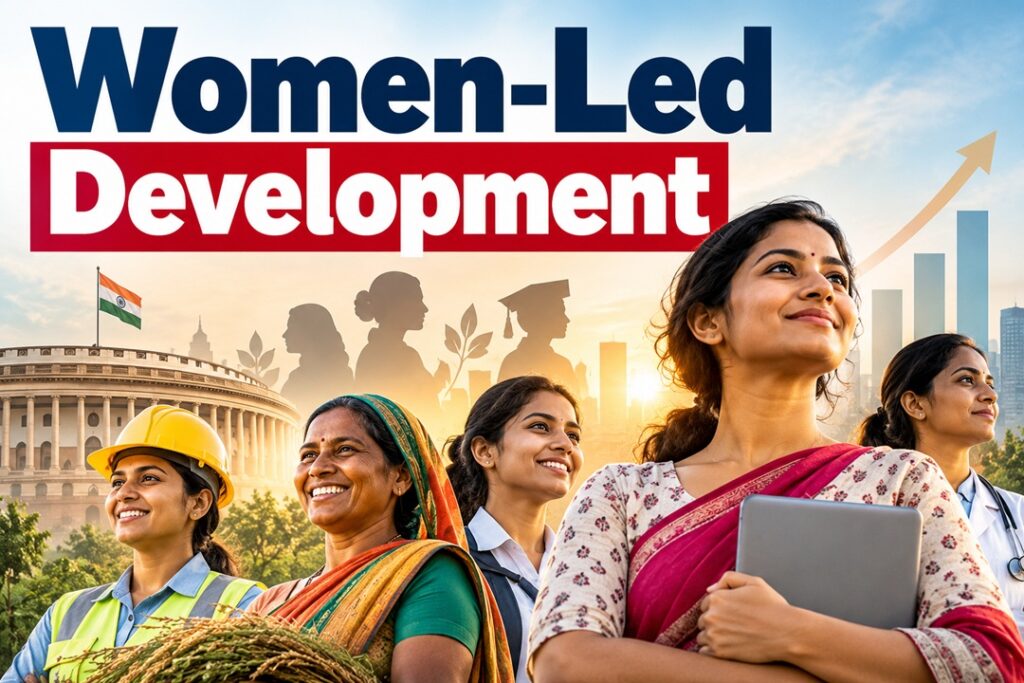
The National Commission for Women (NCW) organised a consultation on women’s property rights and access to social and economic justice, highlighting the need to move beyond welfare-oriented measures towards a development model in which women exercise greater control over resources and participate actively in decision-making.
What is Women-Led Development?
Women-led development recognises women as equal stakeholders, decision-makers and leaders rather than merely recipients of government assistance.
- Economic empowerment: Equal access to property, credit, employment and livelihood opportunities.
- Political empowerment: Greater representation in elected bodies and leadership positions.
- Social empowerment: Ensuring dignity, equal rights and freedom from gender-based discrimination.
- Institutional empowerment: Enabling women to participate in decision-making within public institutions, workplaces and community organisations.
- Legal empowerment: Strengthening awareness of legal entitlements and ensuring accessible remedies for rights violations.
Distributive Justice and Compensatory Justice
Both forms of justice are important for achieving substantive equality, but they address different aspects of inequality.
Distributive Justice
It focuses on the fair allocation of resources, opportunities and social benefits to reduce structural inequalities.
- It seeks to prevent exclusion by addressing unequal access to resources.
- Constitutional provisions: Articles 38, 39 and 46 promote social welfare, equitable distribution of resources and protection of weaker sections.
- Judicial recognition: In Air India Statutory Corporation v. United Labour Union (1996), the Supreme Court discussed distributive justice in advancing an egalitarian social order.
Compensatory Justice
It seeks to remedy the effects of discrimination, exploitation and historical disadvantage through legal protection, compensation and corrective measures.
- It includes victim compensation, protective legislation and affirmative action.
- Constitutional provisions: Article 17 abolishes untouchability, while Article 23 prohibits trafficking in human beings and forced labour.
- Legal mechanism: Section 396 of the Bharatiya Nagarik Suraksha Sanhita (BNSS), 2023, provides for victim compensation schemes.
Key distinction: Distributive justice aims to ensure fair access to resources and opportunities, whereas compensatory justice addresses harm and disadvantage that already exist.
Significance of Women’s Property Rights
- Financial independence: Ownership of land, housing and other assets strengthens women’s economic security and reduces financial dependence.
- Greater bargaining power: Property ownership can enhance women’s influence over household expenditure and family decisions.
- Substantive gender equality: Equal inheritance rights recognise women as independent legal rights-holders.
- Poverty alleviation: Assets can improve access to institutional credit and productive opportunities.
- Intergenerational benefits: Women’s control over resources can support investments in children’s education, nutrition and well-being.
- Protection against vulnerability: Independent assets can provide security in situations involving marital breakdown, widowhood or family disputes.
Constitutional and Legal Framework
India’s constitutional and statutory framework provides important safeguards for women’s equality and property rights.
- Article 14: Guarantees equality before the law and equal protection of the laws.
- Article 15: Prohibits discrimination on grounds including sex. Article 15(3) permits special provisions for women and children.
- Article 21: Protects life and personal liberty, with judicial interpretation recognising the importance of human dignity.
- Article 300A: Provides that no person shall be deprived of property except by authority of law.
Important statutory provisions and judicial decisions
- Hindu Succession Act, 1956: The 2005 amendment granted daughters equal coparcenary rights in Mitakshara Hindu joint family property.
- Vineeta Sharma v. Rakesh Sharma (2020): The Supreme Court clarified that a daughter acquires coparcenary rights by birth, irrespective of whether her father was alive on 9 September 2005.
- Hindu Marriage Act, 1955: Contains provisions relating to matrimonial rights and property-related relief in specified circumstances.
- Special Marriage Act, 1954: Provides a civil framework for marriage and regulates certain associated legal consequences, including succession in applicable circumstances.
Despite these safeguards, effective implementation, legal awareness and access to justice remain essential to ensure that women can exercise their rights in practice.
Major Challenges to Women-Led Development
- Patriarchal social norms: Women may face pressure to relinquish inheritance claims in favour of male relatives.
- Limited legal awareness: Lack of knowledge about succession laws and available remedies prevents women from asserting their rights.
- Procedural and financial barriers: Litigation expenses, delays and complicated documentation make legal remedies difficult to pursue.
- Weak implementation: Formal equality under the law does not always translate into actual ownership or control of assets.
- Land administration difficulties: Inaccurate records and complicated mutation procedures can obstruct women’s claims.
- Nominal ownership: Property may be registered in a woman’s name without giving her meaningful control over its use, income or transfer.
- Unequal decision-making power: Household and community structures may continue to limit women’s participation despite their legal entitlements.
Measures to Strengthen Women-Led Development
- Improve land governance: Digitise land records, simplify mutation procedures and accurately record women’s ownership shares.
- Expand legal literacy: Use Self-Help Groups (SHGs), local governance institutions and community organisations to spread awareness of property rights.
- Strengthen legal aid: Improve access to affordable legal services, counselling and effective grievance-redressal mechanisms.
- Ensure effective enforcement: Monitor compliance with existing laws and address administrative barriers.
- Promote economic independence: Expand access to institutional credit, skill development, entrepreneurship and livelihood opportunities.
- Increase women’s leadership: Encourage meaningful participation in local governance, public institutions and economic decision-making.
- Build institutional coordination: Align policies across land administration, justice delivery, financial inclusion and social protection.
- Transform social attitudes: Promote equal inheritance, shared family responsibilities and recognition of women’s independent legal and economic identities.
Way Forward
A shift towards women-led development requires institutions to move beyond measuring empowerment through welfare benefits alone. Greater emphasis must be placed on whether women actually own assets, control economic resources, understand their legal rights and influence decisions affecting their lives.
Gender-responsive governance, accessible justice, effective land administration and sustained community awareness can help bridge the gap between legal equality and lived experience. Implementation should also address the specific barriers faced by rural women and those with limited access to formal institutions.
Conclusion
Women-led development is essential for achieving inclusive growth and substantive gender justice. Securing women’s property rights, strengthening their economic independence and enabling their participation in decision-making can transform women from passive recipients of development programmes into equal partners in India’s nation-building process.
Source : The Hindu