
India’s AI Data Centre Boom: Balancing Digital Growth with Resource Sustainability
Context
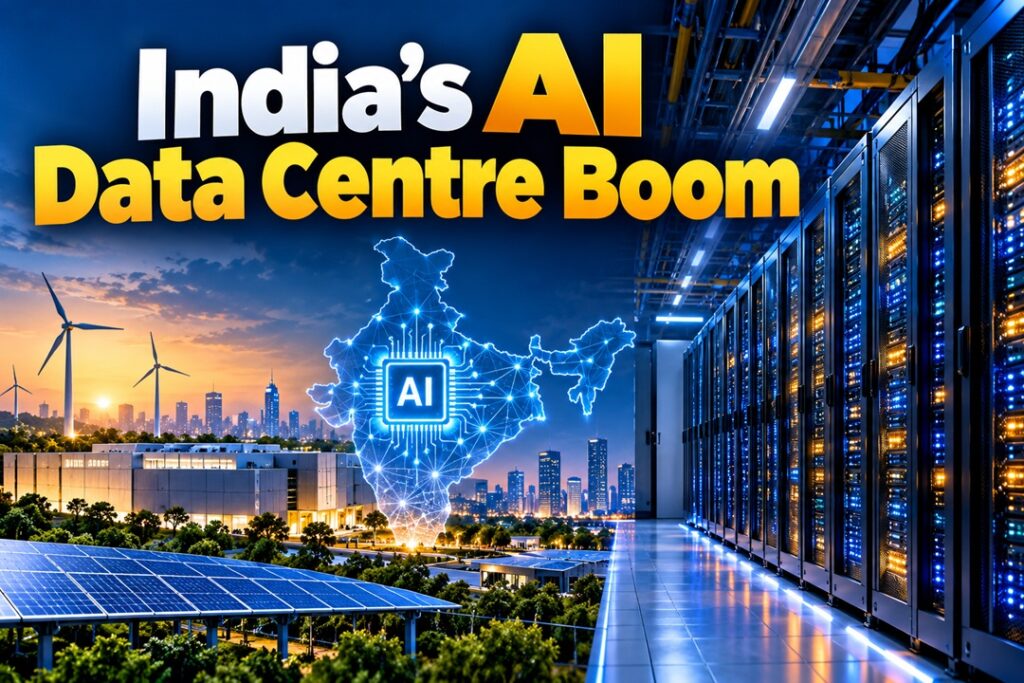
NITI Aayog’s Frontier Tech Hub has proposed a policy framework urging State governments to assess electricity grid capacity, undertake long-term water availability studies spanning 20–30 years, and evaluate measurable economic benefits before approving data centre projects. The recommendations seek to align India’s expanding AI infrastructure with environmental sustainability, resource efficiency and regional development.
Understanding AI Data Centres
A data centre is a specialised facility that houses servers, storage systems and networking equipment to process, manage and store digital information. With the growth of generative AI, conventional data centres are increasingly evolving into hyperscale computing facilities equipped with thousands of Graphics Processing Units (GPUs).
These facilities require uninterrupted electricity and advanced cooling systems to support AI model training, inference and cloud computing services.
India’s Growing Data Centre Industry
- Rapid Capacity Expansion: India’s data centre capacity reached approximately 1.6 GW by mid-2026 and is projected to rise to 6 GW by 2029, according to JLL estimates.
- Large Investment Requirements: Achieving the projected capacity could require around $110 billion in investments across computing hardware, buildings and power infrastructure.
- High Electricity Demand: Individual hyperscale facilities often require more than 20 MW of power, while large campuses may consume over 100 MW.
- Increasing Global Investments: Major technology companies, including Google, Amazon Web Services and Microsoft, are expanding their AI and cloud infrastructure presence in India.
- Digital Economy Expansion: Rising smartphone usage, 5G adoption, online payments, digital entertainment and cloud-based services are increasing the demand for domestic data storage and processing.
- Strategic Computing Capacity: Initiatives such as the IndiaAI Mission aim to strengthen domestic computing infrastructure and support the development of indigenous AI models.
- International Connectivity: Submarine cable landing stations in coastal cities such as Mumbai, Chennai and Visakhapatnam provide links to global digital networks.
Together, these developments offer India an opportunity to strengthen its technological capabilities, attract investment and improve digital infrastructure.
Major Challenges Associated with AI Data Centres
1. Pressure on Electricity Infrastructure
AI data centres require continuous, high-capacity power supply. Concentrated demand can exceed the capacity of local transmission and distribution networks, necessitating expensive infrastructure upgrades and potentially increasing pressure on electricity procurement costs.
2. Water Stress and Ecological Concerns
Evaporative cooling systems can consume substantial quantities of freshwater. Establishing data centres in water-stressed regions may intensify competition among industries, households and agriculture for limited water resources.
3. Limited Direct Employment Generation
Although data centres attract substantial capital investment, they are highly automated and generally create fewer permanent jobs relative to their investment scale. Tax concessions and subsidised utilities may therefore produce limited local benefits unless employment, research and domestic value addition are also considered.
4. Carbon Emissions and Energy Inefficiency
Dependence on fossil-fuel-based electricity and diesel generators for backup power can increase greenhouse gas emissions and local air pollution. Inefficient cooling and power management further raise the environmental footprint of computing infrastructure.
5. Electronic Waste Generation
Frequent replacement of servers, GPUs, batteries and other equipment creates specialised electronic waste. Inadequate collection, recycling and material recovery can increase environmental contamination and resource losses.
6. Uneven Regional Development
Data centres tend to cluster around locations with strong connectivity, reliable power and suitable land. Without appropriate spatial planning, this concentration may intensify regional infrastructure pressure and encourage construction in environmentally sensitive areas.
NITI Aayog’s Key Recommendations
1. Mandatory Electricity Grid Readiness
- Require developers to work with distribution companies (DISCOMs) and State Transmission Utilities to prepare coordinated power infrastructure plans.
- Ensure that facilities exceeding 20 MW incorporate automated demand-response systems connected to State Load Dispatch Centres.
- Assess the additional generation, transmission and distribution capacity required before granting approvals.
2. Long-Term Water Security Assessments
- Conduct water impact assessments covering a 20–30-year period.
- Evaluate groundwater, surface water and municipal supply availability under different climate and demand scenarios.
- Mandate treated wastewater use and water metering, particularly in water-stressed locations.
3. Incentives Linked to Measurable Economic Benefits
- Link fiscal incentives to verified outcomes rather than investment announcements alone.
- Assess domestic equipment procurement, research and development, skilled employment, renewable energy adoption and local economic contributions.
- Periodically review tax concessions and subsidies to determine whether public expenditure is generating commensurate benefits.
4. Designated Development Zones
- Identify data-centre-ready areas with adequate electricity infrastructure, water availability and digital connectivity.
- Prioritise locations with access to renewable energy and sufficient power evacuation capacity.
- Restrict development in ecologically fragile and severely water-scarce regions.
5. Centralised Monitoring and Compliance
- Establish a MeitY-led compliance audit mechanism to monitor the environmental and operational performance of data centres.
- Track Power Usage Effectiveness (PUE), water consumption, carbon emissions and actual renewable electricity use.
- Require periodic reporting and corrective action when facilities fail to meet prescribed standards.
Way Forward
- Adopt Integrated Resource Planning: Data centre approvals should be coordinated with State electricity plans, water security strategies and urban development policies.
- Promote Green Computing: Encourage energy-efficient processors, advanced cooling technologies, heat recovery and improved server utilisation.
- Strengthen Renewable Energy Integration: Expand renewable power procurement, storage systems and suitable grid infrastructure while ensuring reliable electricity supply.
- Encourage Circular Economy Practices: Introduce robust arrangements for equipment repair, refurbishment, recycling and responsible electronic waste disposal.
- Improve Transparency and Accountability: Publish standardised information on energy and water consumption, public incentives, employment generation and environmental performance.
- Ensure Community Benefits: Incorporate local skill development, research partnerships and infrastructure improvements into project-level development plans.
Conclusion
India’s expanding AI data centre industry can strengthen digital sovereignty, support innovation and attract global investment. However, its long-term success will depend on how effectively the country manages the associated demands on electricity, water and the environment.
NITI Aayog’s proposed framework highlights the need to move beyond investment-led expansion towards resource-efficient, environmentally responsible and economically accountable digital infrastructure. A balanced approach can help India build a competitive AI ecosystem while protecting essential natural resources and ensuring that the benefits of technological growth extend to local communities.
Source : The Indian Express